


THERE are as many reasons why the academic environment in college and university campuses nationwide has been deteriorating as there are national political parties. Eruption of violence among student groups has resurfaced with monotonous regularity soon after Awami League's landslide election sweep. Although I had been thinking about this situation for some time now, two successive incidents in one week triggered this piece.
June 26: At least 35 students were hurt as two rival factions of Bangladesh Chatra League (BCL) clashed at Bangladesh Agricultural University in Mymenshing. The clash was about establishing control over student politics, job offerings, drug business, and anything else that may open up money-making opportunities.
June 29: Student activists led by the general secretary of Banpara Degree College (Baraigram Upazila) unit of the BCL physically assaulted a guard and then a teacher who dared to come to his rescue. The guard was enforcing the rule barring students from entering the campus without uniform. The injured were rescued by other students and taken to a local clinic.
Although, Prime Minister Sheikh Hasina officially disassociated herself from the BCL, kerfuffle between factious BCL groups continues -- often violently. Many of us believe that these groups -- some of whom are outside miscreants who masquerade as students -- are the surrogates of local and national AL leaders. The PM should take stern action against these leaders of her party if they are found to be involved in such nefarious activities.
Available evidence indicates that these campus activists are unlikely to be future doctors, engineers, civil servants, academicians etc. Many of them, in all likelihood, are destined to be the future politicians of the country at local and national levels.
The graduates who perform well in public and private universities will take up all the goods jobs the country has to offer while leaving politics of mischief for the under-performers. Many of the under-performers and dropouts are already self-employed in street hooliganism, extortions, land-grabbing and other degrading activities.
Over the span of the last three weeks, I sat with two former vice chancellors -- Dr. S.M.A. Faiz of Dhaka University and Mr. Muslehuddin Ahmad, the founding VC of North South University -- on separate occasions during their visit to Michigan. Among the issues discussed, campus politics topped the list. They both agreed with the prevailing view that only major political parties could extricate campus politics from national parties.
No one is banning student politics; instead student politics should be limited to students' issues such as academic programs, library facilities, classroom conditions, residential halls, dining, sporting activities, health and campus security, plus everything else that uplifts students' well-being.
VC Faiz is in general agreement with the prevailing notion that the quality of graduates from public universities has deteriorated relative to the pre-liberation period. Consequently, overwhelming public opinion has recently swayed towards abolishing student politics altogether.
Both the vice-chancellors stressed that, unlike private universities, students in public universities engage in politics and mischief partly because of weak enforcement of many rules and regulations. They believe requirement of participation in regular debates and seminars on national and international issues would keep them engaged.
Following the models in US, politically ambitious students should be required to engage in community service, work as interns in local and national government offices (such as election commission) and political party offices, and get academic credits.
VC Ahmad reasoned that private universities are free from national party politics, tender manipulations, extortions and other mischief because of the pressure from parents who pay the very high tuition fees, plus the pressure to maintain a minimum GPA for continuation in the program, and the time constraint for finishing their degree within four years. Then there are prospects of landing a high paying job upon graduation -- one that acts as a huge incentive for distancing themselves from engaging in mischief while being a student.
The last caretaker government acknowledged the pragmatism of student politics for developing future leadership, but argued that students', teachers' and workers' organisations and professional bodies should be pursuing their own agendas instead of being pawns in the hands of the political parties.
Student politics in Bangladesh universities had a close parallel with that of the state of Kerala, India, prior to 2004. There were times when college campuses exploded in deadly violence, resulting in death of students. In one incident, a student, when barred from taking an exam for lack of required attendance, sued the college for monetary and emotional damages.
A Division Bench of the Kerala HC, on February 20, 2004, directed the state government and universities to lay down rules and regulations for curbing dharnas, strikes, gheraos and demonstrations by various students' organisations on college campuses (The Hindu, February 21, 2004).
The court said that the educational institutions could lay down a code of conduct and guidelines to be enforced by the principals. The students were bound by the code of conduct, and the students' organisations had no legal right to interfere with the fundamental right guaranteed to the management.
Despite initial protests, the ban on student politics has worked miracles. "There are no political activities, no party-based elections, no union chairman or officials, and no loss of academic days in Sacred Heart College anymore,"(The Hindu, Jan 28, 2006).
Dr. Abdullah A. Dewan, founder of politiconomy.com, is a Professor of Economics at Eastern Michigan University and a board member of ChangeBangladesh Organization, USA.
Thousands of BNP followers this morning thronged the mazar of late president Ziaur Rahman to pay tribute to him on the occasion of his 28th death anniversary.
On this day in 1981, Zia, founder of the BNP, was assassinated by a group of disgruntled army men at the Chittagong Circuit House.
At around 10:55am, BNP Chairperson Khaleda Zia accompanied by a large number of leaders and workers of the party and its front organisations placed a wreath at Zia's mazar at Zia Udyan in the city’s Sher-e-Banglanagar.
She offered fateha at the mazar and prayed seeking divine blessings for the departed soul of her husband.
Khaleda also joined a munajat of `Khatme Quran’ and `milad mahfil’ at the mazar premises, organised by Jatiyatabadi Ulema Dal.
Leaders and workers of BNP’s front and associate organizations and pro-BNP professional bodies also placed wreaths at the mazar.
The BNP chief later inaugurated a voluntary blood donation programme on the mazar premises, which was organised by JISAS.
After the programmes on the mazar premises, Khaleda began distributing cooked foods among the destitute people from Tajmahal road in Mohammadpur.
She was also scheduled to distribute cooked foods among the poor people at about 44 spots in the Dhaka city. The food distribution programme will also continue till Monday.
Leaders of BNP and its front organisations, including BNP Secretary General Khandaker Delwar Hossain, Dr Khandaker Mosharraf Hossain, Shamsul Islam Khan, MK Anwar MP, Mirza Abbas, Sadek Hossain Khoka, Fazlur Rahman Patal, Barkatullah Bulu MP, Habibunnabi Khan Sohel, Azizul Bari Helal, Abul Kashem, Shafiul Bari Babu and Opposition Chief Whip Zainal Abdin Farroque were, among others, present.
CHANGING a society is not possible only through reforming it. Better human relations can only be developed through social change. Even a political revolution cannot bring social change.
People need emancipation. For emancipation, an independent state is necessary. Independence of the state, however, cannot ensure emancipation of the people. Take the case of Bangladesh. Have the people of Bangladesh achieved this emancipation though it became independent twice, once 1947 and the other in 1971. Independence does not mean change of rulers. Emancipation is only possible through social change.
The obstacle to social change comes from within the society. Vested interests will always try to oppose social change because they enjoy facilities and privileges not available to the common people. They will certainly not like to lose these advantages through agreeing to social change.
Even the majority of underdogs do not like change in society because, firstly, they have become habituated to the system. They do not believe that change will be better than the existing situation. In fact, they apprehend a worse situation. Secondly, they accept the present situation as their fate and, as such, it cannot be changed. Thus, it is better to accept it.
It is true that we have been able to develop a lot during the last 38 years. Some people have improved their lot extremely fast and most visibly. They are enjoying all the comforts and privileges from the state. The number of such people is, however, too small. They are developing at the cost of the rest of the population. This is causing discrimination and division in the society.
In a capitalistic system this means development. Socialisation is also destroyed by it. People become introverted gradually, to the extent of considering their dear and near ones as not only their competitors but also, at times, their enemies.
A vast majority of the people is unhappy with the existing situation. They do not see any hope of change for the better. Neither can they dream of a situation where they can enjoy emancipation collectively. Gradually, they are separated and unemployment increases.
The government is committed to offer employment to at least one person from each family. Now it is reported that it may retrench 10% of the government servants. We do not blame the government for this. The fault lies with the system of capitalism, which will force the government to break its commitment.
We do not envisage increase in investment. Some analysts do not see a bright prospect for it in the near future. Some say that as the local capitalists believe more in plundering and not in production there cannot be any appreciable increase in investment. It may be pointed out in this regard that small savers are neglected in the system. This may gradually result in social agitation, which may turn into social revolution.
The objectives of our liberation war were not confined to only setting up of an independent state; they included establishing off a new society in which there will be no social discrimination. People were united to build a democratic society with the ultimate aim of creating a democratic culture.
Education is generally regarded as the backbone of a nation; but truly speaking, culture is the real backbone. This anomaly is due to the influence of capitalism. If nationalism is to be democratic it has to be turned into cultural nationalism.
Are we to continue with the present system? Will there be no change? Surely there will be change. That change will be brought by the democratic people who understand that the present system has to be replaced by a democratic society and culture.
Society is bigger than the state. The hurdles against social change are put up by people who are not interested in the welfare of the common men. The imperialists are ready to assist them. During the war of liberation they did not come openly. Now, they are ready to expose themselves openly.
Our only hope is our people, who are unhappy and angry. If there be any call for change they will respond as they did in 1971. This call will be given by the people who believe in true democracy, think properly and act rightly.
Eminent scientist and husband of Prime Minister Sheikh Hasina, Dr MA Wazed Miah passed away yesterday afternoon in the capital's Square Hospital after a prolonged battle with multiple illnesses.
The prime minister was beside her husband at the moment of his passing away. He had been suffering for long from high blood pressure, diabetes, asthma, and renal failure, and had been undergoing treatment in the hospital for the last one year.
The health condition of Dr Wazed, an internationally renowned nuclear scientist and a former chief of Bangladesh Atomic Energy Commission, started deteriorating for the worst after 2:30pm, and he breathed his last around 4:25pm, doctors said.
His body was taken to his Sudha Sadan residence in Dhanmondi from the hospital around 5:25pm. Hundreds of citizens including ministers, state ministers, lawmakers, leaders of Awami League and its associated organisations, relatives, and admirers thronged Sudha Sadan to express their condolences to Dr Wazed's bereaved family members.
The youngest among four brothers and sisters, Dr Wazed Miah, survived by his wife Sheikh Hasina, son Sajeeb Wazed Joy, and daughter Saima Wazed Putul. Family sources said Joy and Putul were on their way home from the US and Canada yesterday.
Dr Wazed authored many books including Fundamentals of Thermodynamics, and Fundamentals of Electromagnetics, and got a PhD degree from Imperial College London. He got married to Prime Minister Sheikh Hasina in 1968.
Dr Wazed's first namaz-e-janaza will be held at Baitul Mokarram National Mosque in the capital today at 10:00am, then his body will be taken to his village home Fathepur in Pirganj of Rangpur.
He will be buried in his family graveyard after a second namaz-e-janaza there. Family sources said he will be buried next to the graves of his father Abdul Kader Miah and mother Moyzennesa. As the news of Dr Wazed's passing away spread in his village, people expressed profound sorrow.
He lived a quiet life in Sudha Sadan after his retirement. He was also known among relatives and friends as 'Sudha Miah'.
President Zillur Rahman expressed his profound sorrow at the death of Dr Wazed Miah. In a condolence message, he said, "The country has lost an eminent scientist at his death."
"The nation will recall with respect the contributions of Dr Wazed in the development of nuclear science in Bangladesh."
The president prayed for salvation of the departed soul, and also expressed his deep sympathy for members of the bereaved family of the departed.
Speaker Abdul Hamid, Deputy Speaker Col (retd) Shawkat Ali, and cabinet members also condoled the death of Dr Wazed. They also prayed for the departed soul and conveyed deep sympathies to the members of the bereaved family.
"The country has lost a talented nuclear scientist and an open-minded man at the death of Dr Wazed Miah," the speaker said in a condolence message.
KHALEDA'S CONDOLENCE
Leader of the Main Opposition also BNP Chairperson Khaleda Zia condoled the death of Dr Wazed Miah. In a condolence message she said, "As a talented and dedicated scientist, Dr Miah contributed immensely to the development of science and technology in the country. I am deeply saddened by his passing away."
"It will take a long time to fill up the vacuum caused by his death," she said adding, "He deserves great praise and honour for his unique politeness and courtesy, and for his righteousness and devotion to his profession."
Expressing her deepest sympathy to the bereaved family members of the departed, the opposition leader said, "I express my deepest condolences to the prime minister and through her to the rest of the bereaved family." Khaleda prayed for salvation of the departed soul.
Children perform a dance at a programme in DC Hill of Chittagong yesterday marking the end of Bangla year. The programme was organised by Sammilito Pahela Baishakh Udjapan Parishad. Photo: STARStaff Correspondent
As the sun rises above the horizon this morning heralding Pahela Baishakh, the nation will welcome the Bangla year 1416 amid festivity and gaiety.
Leaving behind all sorrow and despair, thousands of men, women and children in traditional colourful clothes throng Ramna Batamul and other programme venues in the capital and elsewhere in the country to celebrate the first day of Bangla year.
A three-tier security system has been put in place at the traditional centres of celebration around Ramna Park, Suhrawardy Udyan and Dhaka University (DU) campus.
Around 10,000 members of police, Rab and Detective Branch of police will keep vigil round-the-clock at the venues to ward off any untoward incident.
About 80 close circuit TVs have been installed at various places while 29 check posts and eight archways have been set up to ensure security.
After visiting Ramna Park yesterday, the minister and state minister for home affairs and the chiefs of law enforcement agencies expressed their satisfaction over the security measures taken in and around the park.
Rab said a total of 6,500 Rab members have been deployed across the country. Of them, 3,500 are deployed in the capital.
Ten people were killed and scores injured in a bomb attack on a Pahela Baishakh function at Ramna Batamul in 2001.
Thousands of people gather at Ramna Udyan where the artistes of cultural organisation Chhayanaut sing the traditional Pahela Baishakh song of Rabindranath Tagore -- "Esho hey Baishakh esho esho"-- to welcome the Bangla new year.
Institute of Fine Arts brings out Mangal Shobhajatra, a colourful procession, from the institute gate in the morning. Besides, cultural functions are to be held at Ramna Udyan, Institute of Fine Arts of Dhaka University (DU) and elsewhere in the capital.
People from all walks of life mill around Baishakhi Mela (fair) -- a major feature of Bangla New Year celebration. They have Panta Bhat and fried hilsha with lentils and green chillies at home and Baishakh gatherings.
The day is a public holiday. Numerous social, political and cultural organisations have taken up elaborate programmes to celebrate the day.
Bangladesh Betar and all television channels air special programmes while newspapers publish special supplements.
Dhaka Metropolitan Police said the roads stretching from Sheraton crossing to Hare Road-Kakrail crossing, from Shahbagh to Matsya Bhaban, from Nilkhet crossing to Teachers-Students Centre (TSC) of Dhaka University, from Plassey intersection to Doyel Chattar via Shaheed Minar and Bakshi Bazar to TSC crossing via Jagannath Hall are off-limits to vehicles.
The Bangla year beginning with Baishakh was introduced during the rule of Mughal Emperor Akbar from 1556-1605.
President Zillur Rahman, Prime Minister Sheikh Hasina in separate messages yesterday greeted the nation on the occasion of Bangla New Year.
The president said, "Pahela Baishakh is a unique day for nurturing our everlasting tradition."
He hoped that the Bangla New Year will 'unite us in all aspects of life and also be the harbinger of joy for all'.
Sheikh Hasina said the Bangla New Year's influence on the lives of Bangalees is diversified. She prayed for salvation of the departed soul and conveyed sympathy to the people who were crippled in the Ramna Batamul bomb blast in 2001.
Hasina asserted that the government would bring the culprits to book through conducting fresh investigation into the bomb blast.
Leader of the Opposition and BNP Chairperson Khaleda Zia said the New Year is an integral part of the national culture and urged all to play their respective roles for upholding Bangla culture in the world arena.
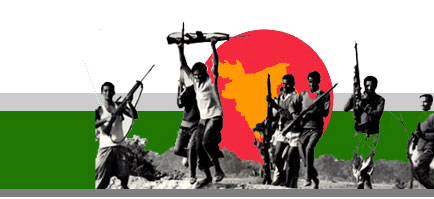
I like to remind us for being proud to be the citizen of an independent country, Bangladesh. But our sacrifice does not end there. After sacrificing huge number of lives and personnel dedication, we become an independent country. This independence has lead us in a new chapter where we should pay tribute for those who have given their lives 38 yrs ago.
I still think that we did not implement the dream of lost lives. It's long way to go, but we never should afraid to be successful. Lets talk about few successes and huge failures in the last 38 years:
BD Successes:
1) In 38 years, huge number of Bangladesh moved to various countries in the world. Few of them became well established businessmen, few have acquired prestigious education and serving fortune 100, 500 companies, few of them in education sector, few of them serving host countries as being good workers. We Non Resident Bangladeshi (NRBs) have established a credible platform in foreign countries.
2) NRBs sends more than $8 Billion per year to BD which helps people in Bangladesh and as well as Govt.
3) Few NRBs went back home to serve in various sectors to bring back the education and technologies that are needed for the 21st century.
4) Few of Bangladesh companies have earned prestige in the international markets (i.e. garments, ship buildings, shrimp exporting, etc.). This is happened because of our Independence too.
BD Failures:
1) In the last 38 years, there are multiple people run the countries and have created partisan politics which hampered the country growth. Few of them used hartal, vandalism, and violence to gain their power.
2) Student politics was created where proper education is lacking in Bangladesh except few universities.
3) Few of the BD leaders did not help to re-conciliate the hatred among various political parties supporters. This also has created unrest among various locations, colleges and universities.
4) Family politics also hurts Bangladesh more than ever.
5) Income between poor and rich has widen. Sometimes corruption has created this gap wider than it should.
6) BD Govts never asked help from NRBs to help the countries or created the policies to attract them. If we look at India, their biggest help comes from NRIs. BD Govt never realized and even today they are blind in this issue.
7) Previous and current BD Govt are not helping to brighten the image of Bangladesh to abroad. If a son of a family with 5 kids becomes trouble makers, we should not call the whole family the trouble maker, but we should counsel or guide the one who is trouble maker. What is happening in BD? A few trouble makers in BD creating the image that the country is bad and people are also bad. BD Govt is not helping either.
8) Politics in BD is not helping to create good image in abroad. This could be reason of short knowledge, ignorance, or power hungry in BD. BD Govt should work to eliminate the anti-Bangladesh propaganda with understanding the international politics. Its easy to seed the bad image but it takes generation to wipe out the bad image.
I still believe that there are good people both in AL & BNP and believe inclusion for good blood into the political parties too. Bangladesh will have to live with both AL & BNP and we all should help them to be successful for the sake of 160 Million people and the country.
I still believe that NRBs are in the front line to help Bangladesh and her economy.
God bless Bangladesh and her people!
Regards,
M M Chowdhury (Mithu), USA
Director, Poltical and Economical Development in Bangladesh